NEXO already had durable memory, nightly transcript-aware Deep Sleep, diaries, reminders, followups, and a new hot-context layer for the last 24 hours. But there was still a real gap in practice: sometimes the operator knew the conversation happened today, the transcript existed on disk, and yet the public MCP surface had no direct fallback path to recover that conversation honestly.
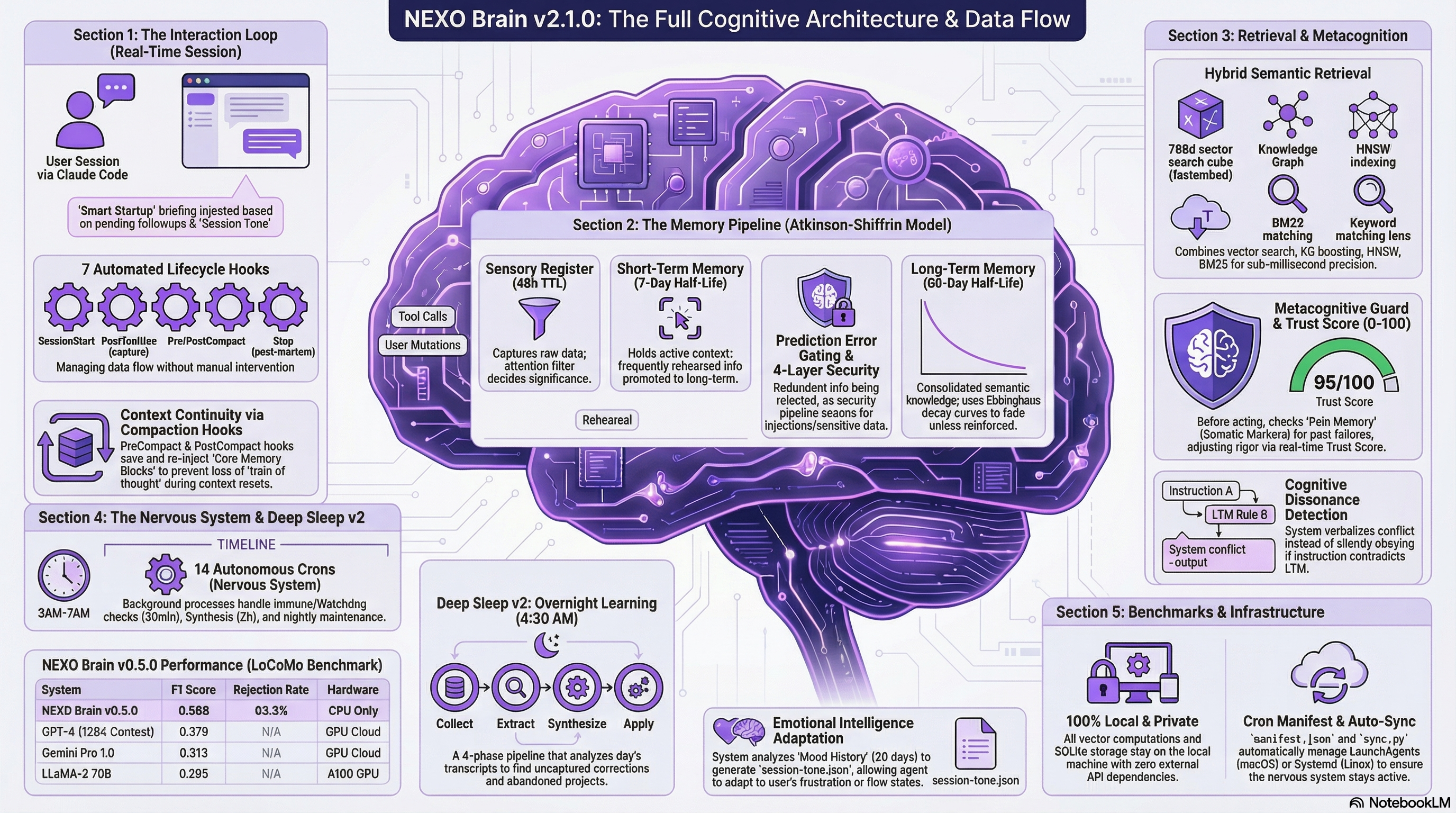
The First Layer Is Still Hot Context
The right first answer to recent continuity is not "search raw transcripts every time". That would be noisy and expensive. The first answer is still hot context: recent operational topics, states, and events that stay alive across sessions, clients, cron ticks, and channel changes.
That layer was already present in the 3.1.x line. It keeps active topics explicit instead of hoping the runtime can reconstruct the last few hours from diaries and durable recall alone.
Now There Is A Public Fallback When That Layer Misses
3.2.0 adds a second layer: recent transcript fallback through MCP.
New tools:
nexo_transcript_recentnexo_transcript_searchnexo_transcript_read
This matters because there is a big difference between:
- "the runtime has no evidence this happened"
- "the recent-memory layer is thin, but the conversation absolutely exists in the transcript store"
With 3.2.0 the public MCP surface can now recover that second case directly. If hot context and recall are not enough, NEXO can search recent Claude Code and Codex transcripts and read the actual conversation.
Deep Sleep And The Public Fallback Now Share The Same Parser
This release also removes a quieter risk: parser drift. Deep Sleep already had transcript access internally, but a public fallback built on a different parser would slowly diverge.
Instead, 3.2.0 extracts transcript parsing into a shared module used by both Deep Sleep and the new public transcript tools. The overnight analyst and the operator-facing fallback now look at the same raw reality.
NEXO Can Also Inspect Itself Now
The second missing piece was not about user memory. It was about NEXO's self-knowledge.
People naturally ask things like:
- What tools does NEXO have right now?
- What plugin exposes this behavior?
- What scripts, skills, crons, projects, and artifacts exist in this runtime?
Until now, the answer was scattered across docs, code, the plugin registry, the script registry, project atlas, and operator memory. 3.2.0 turns that into a first-class runtime surface through:
nexo_system_catalognexo_tool_explain
Why We Call It A Live System Map
This is not a hand-maintained markdown index pretending to be a runtime ontology.
The catalog is built from canonical sources at read time:
- core tools from
server.py - plugin tools from the plugin registry and live modules
- skills from the skill registry
- scripts from the script registry
- crons from the cron manifest
- projects from the project atlas
- artifacts from the artifact registry
So when the runtime changes, the map changes with it. That is the important product difference.
The New Mental Model
The practical ladder for recent continuity is now:
- Hot context first for active recent work
- Transcript fallback second for "we know we discussed this today"
- Live system catalog when the question is about NEXO itself rather than the user's work
That gives NEXO a much more honest answer to two common operator complaints: "you should still remember this from today" and "tell me what you actually have in this runtime."
Install or Update
New install:
npx nexo-brainExisting installation:
nexo updateThen use the recent-memory doc, the changelog, or the new MCP tools directly if you want the runtime to recover a recent conversation or explain its own current surface more honestly.