NEXO already had strong durable memory, recent-memory continuity, transcript fallback, Deep Sleep, trust, and a live system catalog. But there was still an uncomfortable gap between what the runtime knew internally and what it exposed as an operator-visible memory product.
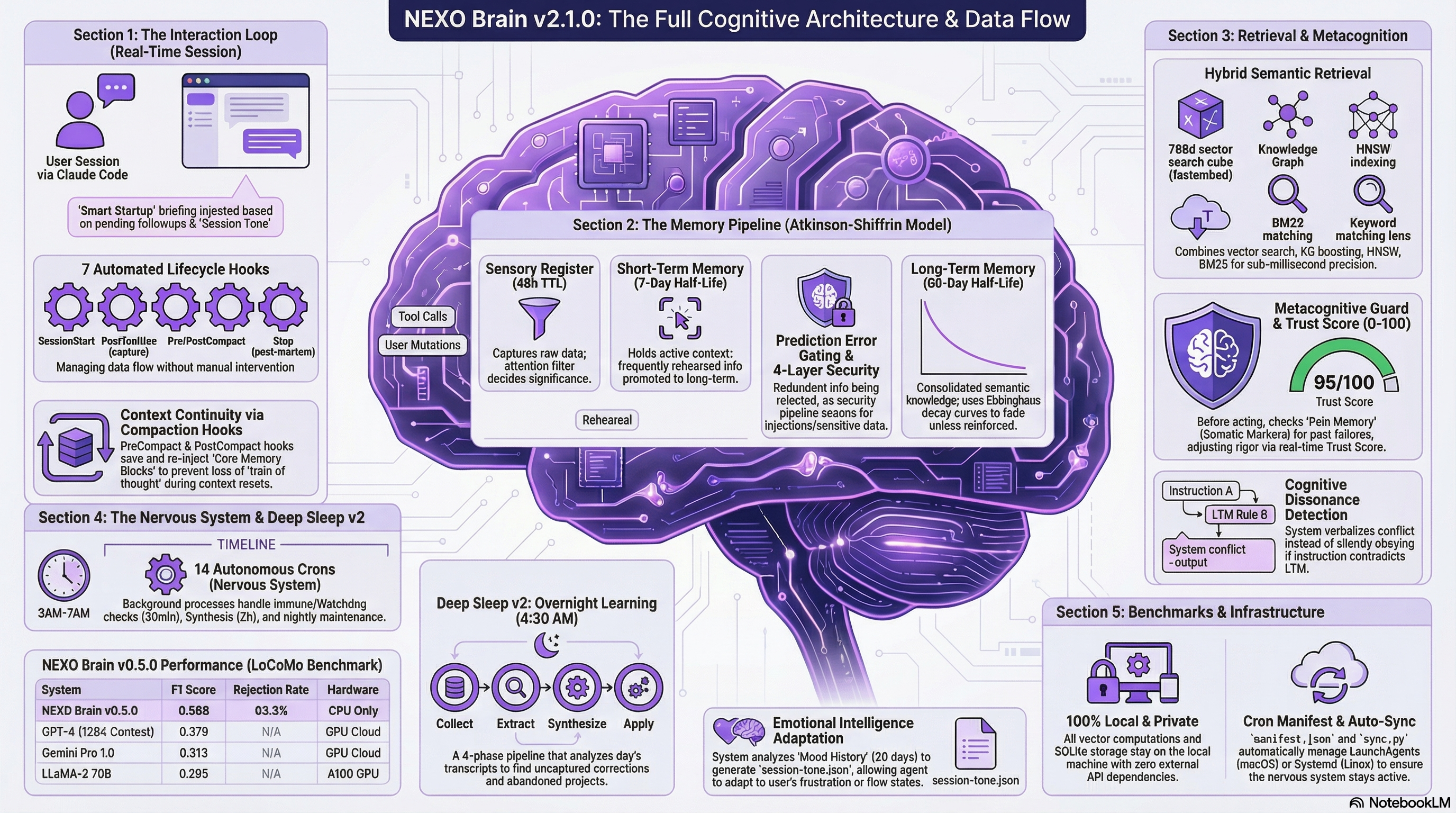
Non-Text Artifacts Finally Belong To Memory
Until now, screenshots, diagrams, PDFs, audio clips, and other non-text artifacts mostly lived outside the real memory model. You could describe them in text, but that is not the same as giving them a first-class identity.
4.0.0 adds a lightweight multimodal reference layer through:
nexo_media_memory_addnexo_media_memory_searchnexo_media_memory_getnexo_media_memory_stats
The first step is deliberately practical: artifact references plus structured metadata, linked back into the wider memory system. That gives NEXO a real upgrade path toward deeper multimodal retrieval later without pretending it already ships a full vision embedding stack.
Compaction No Longer Depends Only On Discipline
Before this release, NEXO had checkpoints and emergency continuity paths, but there was still too much reliance on remembering to save the right thing at the right moment before context compression.
4.0.0 adds structured pre-compaction auto-flush. The pre-compact hook now captures a summary, next step, and tool-activity bundle into a dedicated continuity layer, feeds that into recent context, and exposes it through:
nexo_auto_flush_recentnexo_auto_flush_stats
The important change is not just persistence. It is that this persistence is now visible, queryable, and testable instead of living as a private best effort.
The Claim Graph Now Feels Like A Public Knowledge Wiki
NEXO already had ingredients for factual memory and contradiction handling, but too much of that lived in separate layers and internal surfaces. 4.0.0 turns claims into a clearer public product with evidence, freshness, verification state, linting, and explicit linking.
New public surface:
nexo_claim_addnexo_claim_searchnexo_claim_getnexo_claim_linknexo_claim_verifynexo_claim_lintnexo_claim_stats
This is the closest NEXO has come so far to an inspectable internal wiki of what it currently believes, why it believes it, and how stale that belief may already be.
You Can Read The Memory Bundle Now
One of the oldest objections to serious memory systems is simple: "show me." If the memory is only visible through database tables and ad-hoc queries, it is harder to trust and harder to audit.
4.0.0 adds nexo_memory_export, which writes a readable markdown bundle covering learnings, decisions, claims, media memories, auto-flush records, user-state, and cognitive stats. The database stays the source of truth, but the runtime now has a human-readable export surface on purpose.
User Adaptation Gets A Stronger State Model
Sentiment alone is too shallow for a serious operator model. 4.0.0 adds a stronger inspectable user-state surface that combines trust, corrections, hot-context pressure, diary signals, and sentiment distribution.
That surfaces as:
nexo_user_statenexo_user_state_historynexo_user_state_stats
The goal is not pseudo-psychology. The goal is a better runtime answer to questions like: is the user in flow, urgent, frustrated, overloaded, or stable, and how should the system adapt without becoming opaque?
Retrieval And Backend Assumptions Are Clearer Too
Two other improvements matter because they reduce hidden magic.
- Retrieval knobs:
nexo_cognitive_retrievenow exposes more public control over hybrid weighting, decomposition, dream exclusion, and dormant-memory handling. - Backend contract: newer memory layers now declare an explicit backend contract instead of silently assuming one storage shape forever, surfaced through
nexo_memory_backend_status.
Neither change is flashy on its own. Together they make the system more legible and more evolvable.
Also Included: The Unreleased Work Since 3.2.0
4.0.0 is not only the new memory-surface package. It also folds in the unreleased changes that were already sitting after 3.2.0: stronger protection around live-repo automation writes, richer tool explanation output, the Deep Sleep collection import-path fix, and the core-vs-personal ownership hardening that makes updater and doctor boundaries more explicit around scripts and auxiliary LaunchAgents.
The Practical Upgrade
New install:
npx nexo-brainExisting installation:
nexo updateIf you want the exact release contents, open the 4.0.0 section of the changelog. If you want the short product story, it is this: NEXO memory is now broader, more inspectable, and more honest before, during, and after active work.